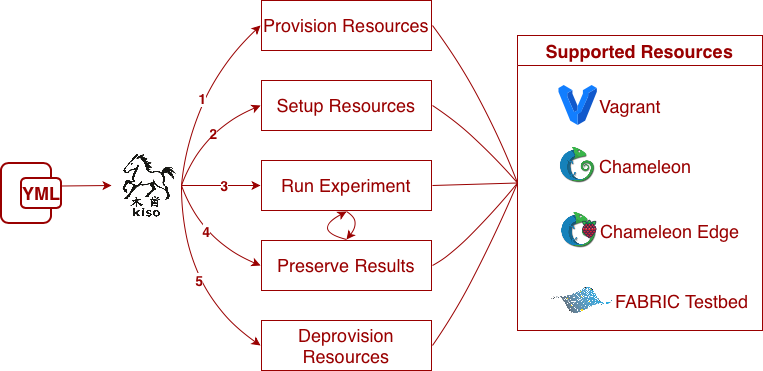
Kiso helps researchers run and reproduce experiments across edge, cloud, and testbed environments, like FABRIC, Chameleon, etc. Define your experiments declaratively, and let Kiso handle the infrastructure complexity.
# Install Kiso
$ pip install kiso[all]
# Define your experiment in YAML
$ vim experiment.yml
# Provision resources across multiple testbeds
$ kiso up
# Run across multiple testbeds
$ kiso run
# Deprovision resources
$ kiso down

You write custom scripts to provision resources, install software, and manage (start, wait, stop) execution instead of focusing on your experiment.
Need to learn testbed-specific APIs to do the above.
You focus on designing and evaluating your experiments rather than managing infrastructure
Kiso handles resource provisioning, software setup, experiment execution, and result collection
Kiso supports FABRIC, Chameleon, and Vagrant testbeds, and can run Shell and Pegasus workflow experiments.
Kiso manages every stage of your experiment with YAML-based configurationβno custom orchestration code required
Declaratively provision computing resources across one or more supported testbeds. Kiso handles authentication, allocation, and configuration across diverse infrastructure providers.
Automatically install and configure software stacks, workload management systems, and execution environments. Deploy containers, workflow engines, agent runtimes, and custom dependencies.
Run experiments in a controlled, repeatable manner across distributed infrastructure. Automatically collect results from all resources back to a central location for analysis.
π Starter Example: A basic hello world example for FABRIC testbed
View on GitHubπ€ Pydantic Agent: A template for running AI agent workloads on provisioned infrastructure: spins up Ollama with a local LLM and a Pydantic agent that returns structured output.
View on GitHub㪠COLMENA: Hyper-distributed agent swarms across heterogeneous edge devices, coordinated as a unified computing platform spanning the full compute continuum.
View on GitHubπ Starter Example: A basic hello world example for Chameleon testbed
View on GitHubπ¦ Plankifier: Deep learning classification of freshwater plankton images to automate ecosystem monitoring at scale, replacing costly manual microscopic annotation.
View on GitHubπ Starter Example: A basic hello world example for Vagrant
View on GitHubπ Orcasound: Real-time orca detection using hydrophone sensors across Washington state, training on live audio to identify whale calls with automated ML pipelines.
View on GitHubEverything you need to run reliable, reproducible experiments across distributed environments
YAML-based experiment specifications capture what should run, where, and howβensuring complete reproducibility without custom code.
Seamlessly run experiments across edge, and testbed environments through a unified interface. Support for major research testbed providers.
No more writing and maintaining custom orchestration code. Define everything in YAML and let Kiso handle the complexity.
Plugin architecture supports custom software installers, and experiment orchestrators to fit your specific needs.
Robust error handling and automated resource cleanup ensure your experiments run smoothly and don't leave resources stranded.
Automatically collect experiment results from all distributed resources to a central location for easy analysis and sharing.
Real-world research experiments powered by Kiso
A template for running AI agent workloads on provisioned infrastructure: spins up Ollama with a local LLM and a Pydantic agent that returns structured output.
Deep learning classification of freshwater plankton images to automate ecosystem monitoring at scale, replacing costly manual microscopic annotation.
Real-time orca detection using hydrophone sensors across Washington state, training on live audio to identify whale calls with automated ML pipelines.
Hyper-distributed agent swarms across heterogeneous edge devices, coordinated as a unified computing platform spanning the full compute continuum.
Join researchers using Kiso to simplify their edge-to-cloud experimentation workflows